
California university health insurance plans include mandates, coverage for abortion, 'hormone therapy'
As tuition skyrockets, students are quietly saddled with costly health plans that not only inflate the price of college but also fund abortions, transgender surgeries, and hormone treatments.
As college tuition continues to soar and campus policies grow increasingly political, students are hit with yet another hidden cost: mandatory health insurance fees that can add thousands to an already high price tag.
Under California law, most people in the state are required to have health insurance, but how schools enforce the regulation with students varies widely. Some universities impose tight deadlines and automatically enroll students in expensive campus plans unless they take action to waive out, while others don’t require insurance at all.
Missing a school’s waiver deadline could mean students are made to pay for thousands of dollars of unwanted coverage.
Campus Reform has investigated how public and private universities differ in structure, cost, and student services, and how policies like UC’s highlight ideological priorities infiltrated throughout campus life.
California’s public universities are quietly adding thousands to students’ bills through mandatory health plans that fund abortion, hormone therapy, and other ideological services.
Public University Systems
1. University of California (UC)
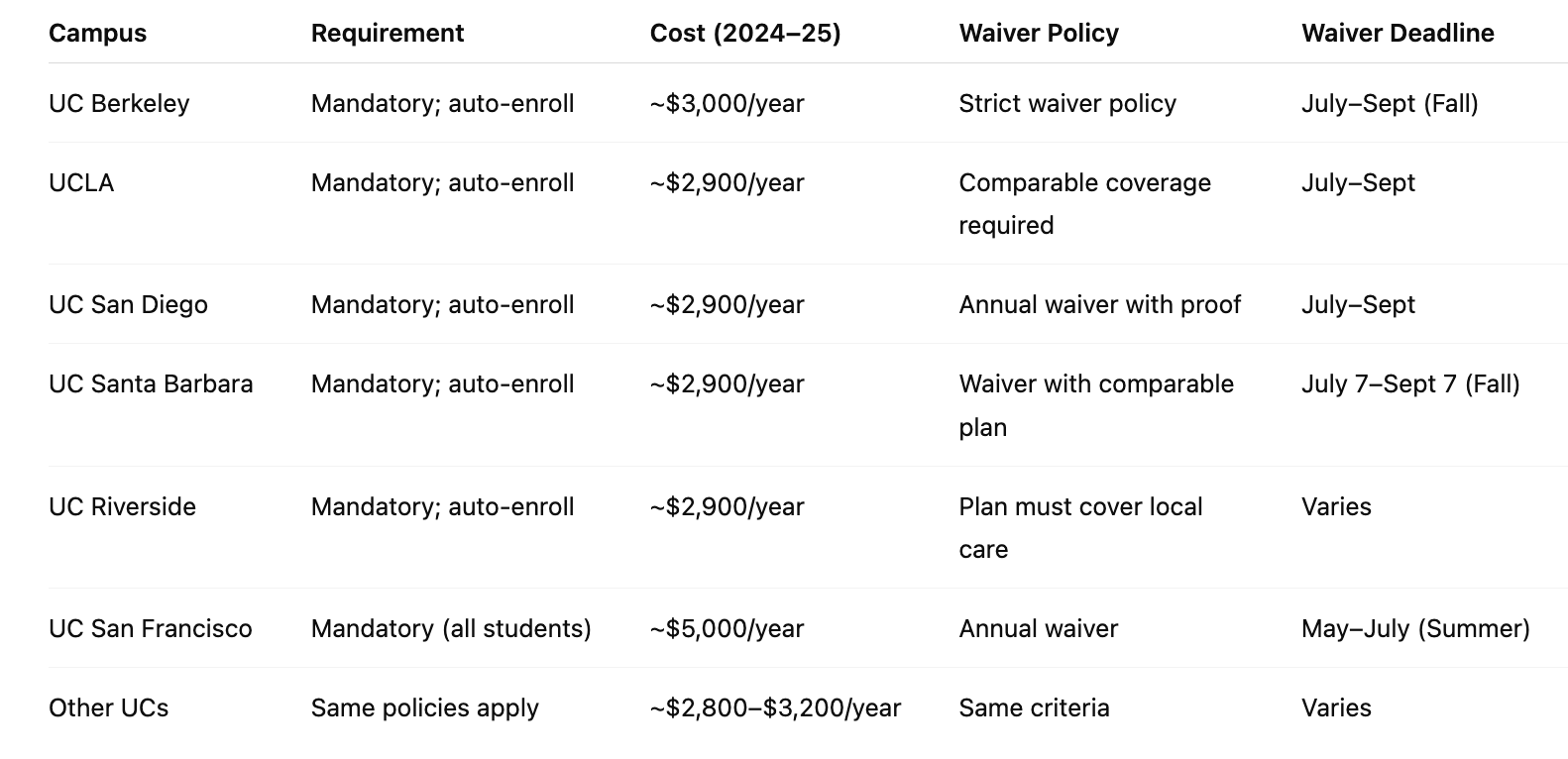
All UC undergraduates are automatically enrolled in UC SHIP, a student plan that covers abortions, transgender surgeries, hormone therapy, and birth control. At UC Berkeley, the plan costs nearly $3,000 per year.
To opt out students must meet strict criteria, including local provider access, low deductibles, and no lifetime limits, and must submit documentation every year.
If students miss the waiver deadline, they’re billed for a plan covering the entire academic year.
 Created with Perplexity
2. California State University
Unlike the UC system, CSU does not require domestic undergraduate students to carry health insurance. However, international students must enroll in campus-sponsored plans or show proof of continuous coverage.
Each CSU campus funds on-site health clinics through student fees, providing basic care without insurance. Health clinics use student fees to offer services like ”medication abortion services” and ”gender affirming care” such as ”feminizing and masculinizing hormone therapy.”
3. California Community Colleges
There is no system-wide health insurance requirement for California Community Colleges. Domestic students are not required to have insurance.
Private Universities
Most major private universities in California require students to carry insurance and auto-enroll them in costly plans unless they file a waiver proving they have comparable coverage.
Insurance plans at private universities can be even more costly than plans at public universities. Stanford University’s plan is estimated to set students back more than $7,000 for the year.
 Created with Perplexity
Campus Reform has contacted the UC Office of the President and Stanford University for comment. This article will be updated accordingly.