Conservative students self-censor at Brown University: POLL
A recent poll at Brown University indicates that conservative students on campus are far more likely than their liberal peers to self-censor in both social settings and the classroom.
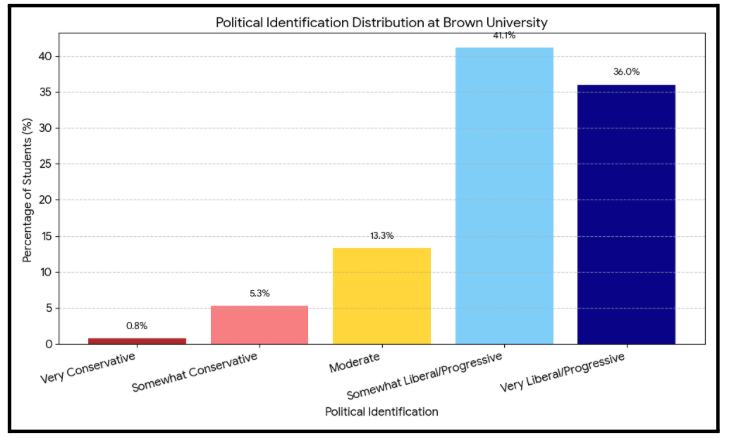
78 percent of respondents identify as liberal or progressive, while fewer than 7 percent identify as conservative.
A fall 2025 poll from The Brown Daily Herald at Brown University indicates that conservative students on campus are far more likely than their liberal peers to self-censor in both social settings and the classroom.
The survey of 1,369 undergraduates found that 78 percent of respondents identify as liberal or progressive, while fewer than 7 percent identify as conservative. The political imbalance influences daily interactions: 72 percent of conservative students reported being afraid to share their political views in social situations.
Liberal and progressive students reported similar fears at significantly lower levels, ranging from 37 percent to 40 percent.
 Generated by Gemini AI
The pattern continues in academic spaces. More than half of conservative students said they feel uncomfortable speaking openly during class discussions.
A separate poll from The Brown Herald found that nearly 70 percent of Brown students value friendships with peers who share their political ideology, intensifying social pressure on ideological minorities.
[RELATED: Conservatives ‘self-censor’ three times as much as liberal counterparts, study finds]
National data identify similar trends. The Foundation for Individual Rights and Expression (FIRE) released its 2025–2026 College Free Speech Rankings, which document declining support for open expression on campuses nationwide. Conservative students across participating colleges reported higher self-censorship than their liberal peers.
Self-censorship among conservatives is not new.
Campus Reform previously reported similar findings at the University of North Carolina, where a study revealed that “Most alarmingly,” the report states, “the proportion of self-identified conservatives who censored themselves at least once (67.9 percent) is almost three times as large as the proportion of self-identified liberals who did the same (24.1 percent).”
At Furman University, research from the American Council of Trustees and Alumni (ACTA) and College Pulse revealed wide ideological gaps. Republican students were significantly more likely than Democrats to report experiencing or observing incivility toward people who share their views.
[RELATED: Nearly 40% of Furman students think ‘shouting down’ speakers is acceptable, survey finds]
Students at other universities describe similar experiences. Damien Loera, a conservative student at Arizona State University’s West campus, told Campus Reform about how navigating a largely liberal environment pushed him to become more outspoken.
“I used to be afraid to speak out,” Loera said. “Since I have been in college, I am no longer afraid and instead have debated ideas rather than shut them down. I started a Turning Point USA chapter here at Arizona State University - West Campus. It was later revealed to me that a certain dean from the campus did not want me to create that chapter on the campus.”
Loera told Campus Reform that regardless of the pushback, he was eventually able to create the chapter.
”It created a lot of controversy. I will never be afraid to speak out regardless of the repercussions,” Loera said. “Nobody will defend your ideals better than yourself.”
Their growing reluctance to express political views reflects a concerning national trend—one in which fear of backlash leads many conservative students to self-censor, raising questions about the future of free expression in America’s higher education system.