
Health insurance requirements at Washington universities could leave students owing thousands of dollars
While international students are the primary group required to purchase health insurance, some universities extend the mandate to domestic students as well.
As students across Washington State return to campus, universities are enforcing updated health insurance requirements that can vary sharply between institutions.
Annual costs range from roughly $1,500 to nearly $4,600, depending on the school. In most cases, international students are the primary group required to enroll, but some private colleges extend mandatory coverage to all undergraduates. Missing waiver deadlines typically means automatic enrollment in a school-sponsored plan, creating another steep bill on top of tuition.
Public Universities
Public universities in Washington State generally limit mandatory coverage to international students, with automatic enrollment unless comparable proof of insurance is provided. Domestic students at these schools typically aren’t required to buy into university-sponsored plans.
 Created with Perplexity
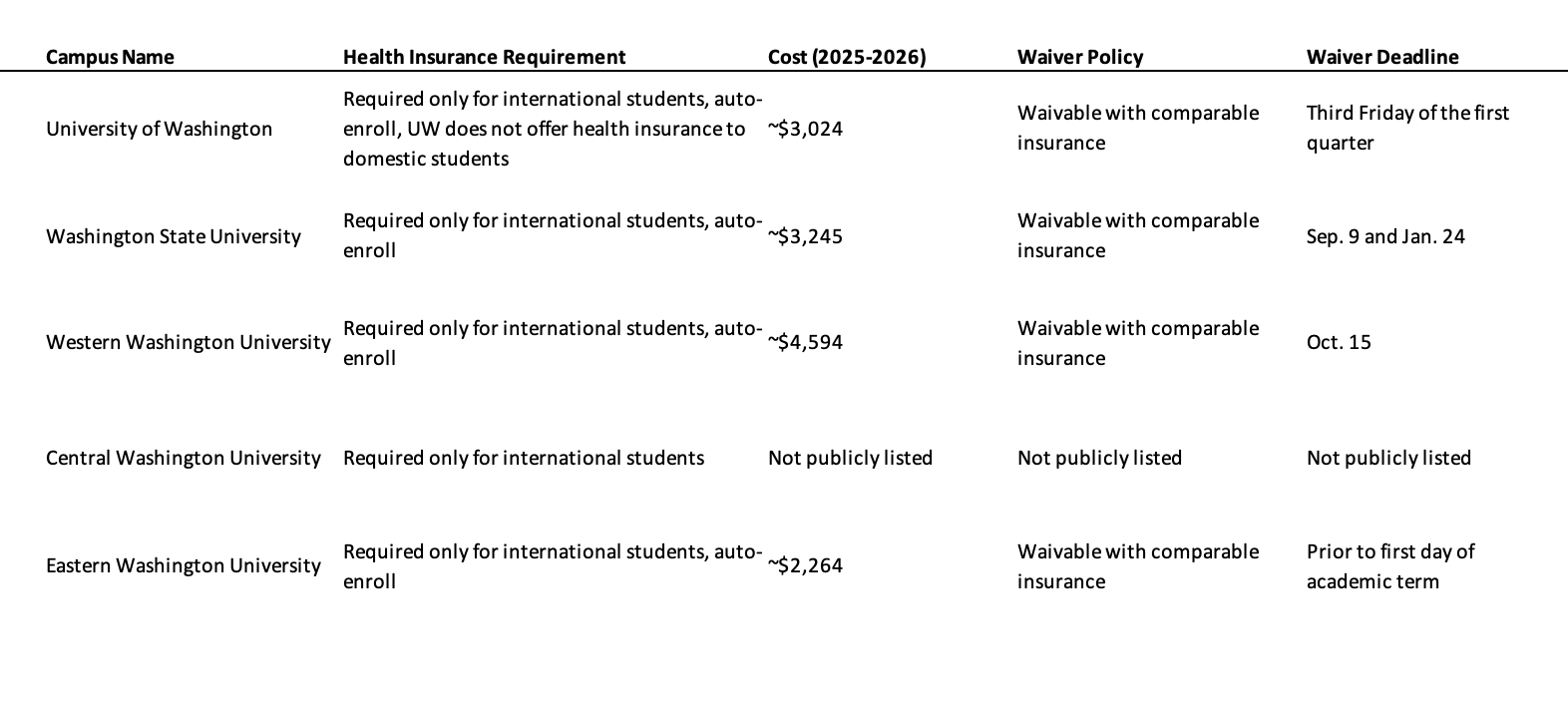
University of Washington – Mandatory for international students only. UW does not offer health insurance to domestic students. Cost: ~$3,024. Waivable with comparable coverage. Deadline: Third Friday of the first quarter.
Washington State University – Mandatory for international students only. Cost: ~$3,245. Waivable with comparable coverage. Deadlines: Sep. 9 and Jan. 24.
Western Washington University – Mandatory for international students only. Cost: ~$4,594. Waivable with comparable coverage. Deadline: Oct. 15.
Central Washington University – Mandatory for international students only. Cost not publicly listed. Waiver policy and deadline not publicly listed.
Eastern Washington University – Mandatory for international students only. Cost: ~$2,264. Waivable with comparable coverage. Deadline: Prior to first day of academic term.
Private Universities
Private universities in Washington, by contrast, often impose broader requirements, sometimes extending to all undergraduates, and enforce strict waiver rules. Costs also tend to be lower than the highest public university premiums, but most students are automatically enrolled unless they secure exemptions.
 Created with Perplexity
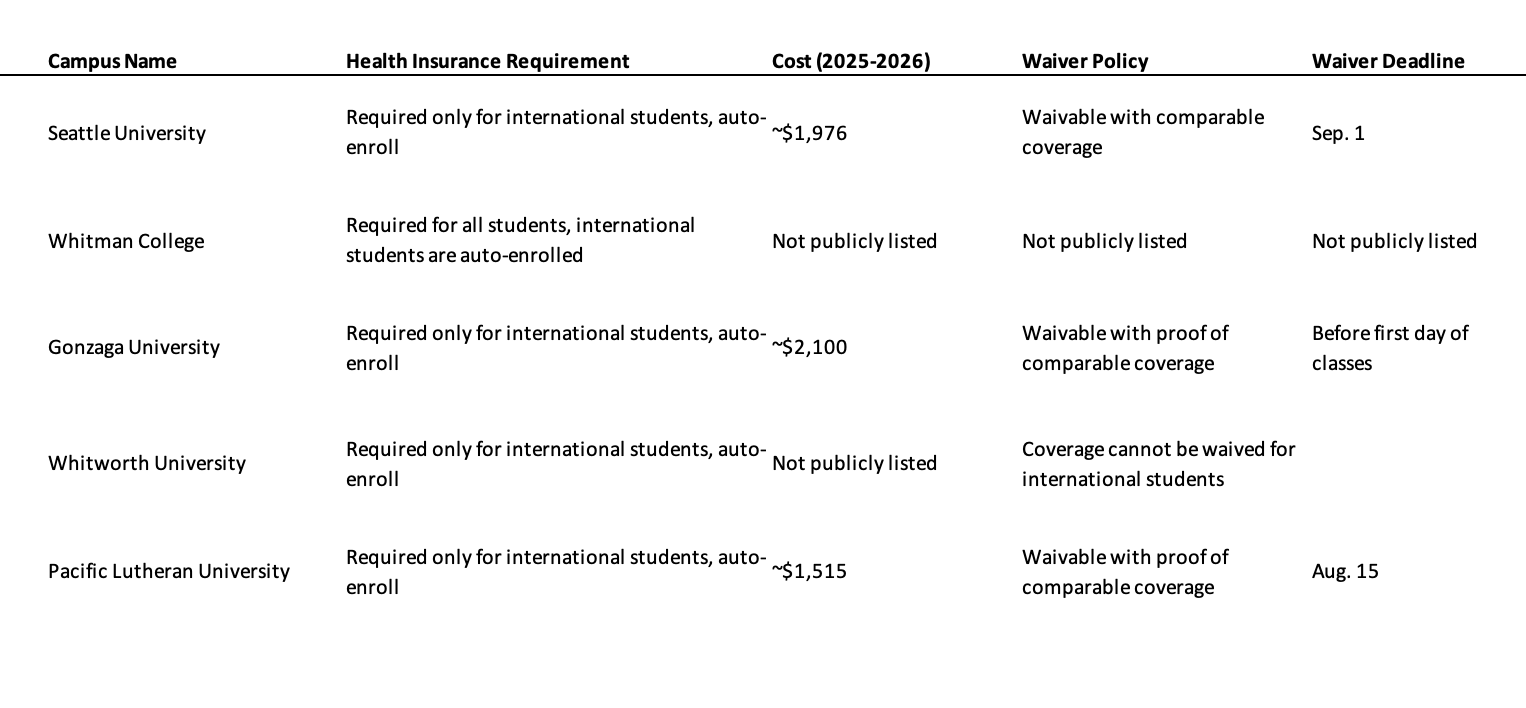
Seattle University – Required for international students only. Cost: ~$1,976. Waivable with comparable coverage. Deadline: Sep. 1.
Whitman College – Required for all students; international students are auto-enrolled. Cost: Not publicly listed. Waiver policy and deadline not publicly listed.
Gonzaga University – Required for international students only. Cost: ~$2,100. Waivable with proof of comparable coverage. Deadline: Before first day of classes.
Whitworth University – Required for international students only. Cost: Not publicly listed. Coverage cannot be waived for international students.
Pacific Lutheran University – Required for international students. Cost: ~$1,515. Waivable with proof of comparable coverage. Deadline: Aug. 15.
Many public and private universities in Washington do not mandate or offer health insurance for domestic students. Gonzaga University, for example, noted that “students could get the same amount of coverage through the [Washington Health Benefit Exchange] for a much better price than we were able to offer.”
For many families, these blanket policies could represent yet another hidden cost of higher education. A student who misses a waiver deadline could be billed thousands of dollars for coverage they already have under a parent’s or personal plan. In some cases, the school-sponsored plans cost more than double what comparable coverage would run on the open market.
The Government Accountability Office has found that most undergraduates in the U.S. are already insured, which raises questions about whether these mandates serve students—or simply pad university revenue streams. As tuition continues to climb, Washington’s example highlights how health insurance rules have become yet another way colleges can extract more money from students while offering little flexibility in return.
For students and their families, accurately navigating health insurance mandates and waiver requirements can result in thousands of dollars saved.