
Massachusetts students may be auto-enrolled in insurance plans that costs thousands
Both public and private universities across Massachusetts require health insurance for students, with many auto-enrolling attendees in expensive school plans.
Students must navigate waiver procedures accurately to avoid costly automatic charges.
College students in Massachusetts face a broad range of health insurance costs and waiver policies, depending on whether they attend a public or private university—differences that can mean paying thousands more per year for essentially the same coverage.
Under Massachusetts law, most residents are required to carry health insurance that meets state standards. This mandate is extended to students attending college in the state.
Students who don’t waive coverage using an eligible policy are automatically enrolled in a campus plan, with costs ranging from under $2,500 to more than $6,000 annually.
[RELATED: Massachusetts Teachers Association pushes tax on ‘richest 1%’ to fund free college]
Public University Systems
Students attending University of Massachusetts (UMass) campuses or the Massachusetts College of Liberal Arts (MCLA) are subject to automatic enrollment if they meet minimum credit-hour thresholds. These schools allow waivers for students who already have comparable or ACA-compliant coverage and generally offer some of the most affordable plan options in the state.
 Created with Perplexity
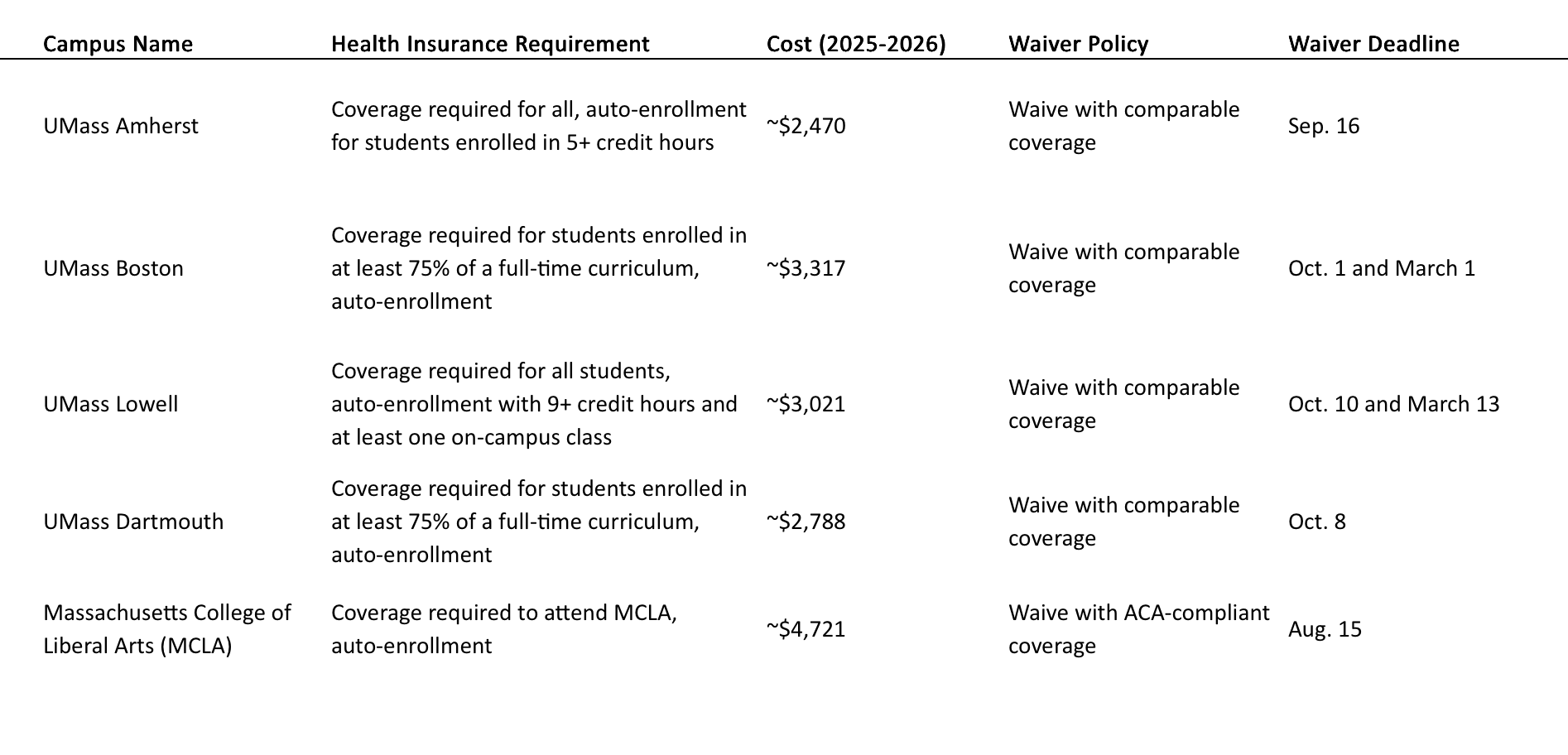
UMass Amherst requires coverage for all students enrolled in 5 or more credit hours and charges ~$2,470 for the 2025–2026 academic year. Waivers are due by Sep. 16.
UMass Boston mandates insurance for students enrolled in at least 75% of a full-time curriculum. The ~$3,317 plan can be waived with comparable coverage. Deadlines: Oct. 1 and March 1.
UMass Lowell enrolls students who take 9+ credit hours with at least one on-campus class. The ~$3,021 cost is one of the lowest among major Massachusetts universities. Waivers: Oct. 10 and March 13.
UMass Dartmouth follows the 75% enrollment rule and auto-enrolls eligible students in its ~$2,788 plan, waivable with comparable coverage. Waiver deadline: Oct. 8.
Massachusetts College of Liberal Arts (MCLA) requires insurance for all enrolled students and charges ~$4,721. MCLA accepts ACA-compliant coverage for waivers, with a deadline of Aug. 15.
Private Universities
Private institutions in Massachusetts often impose higher costs and tighter restrictions on waivers, requiring that policies meet Massachusetts state standards rather than just federal ACA requirements. Most also automatically enroll all full-time students and add health insurance charges unless a waiver is submitted on time.
 Created with Perplexity
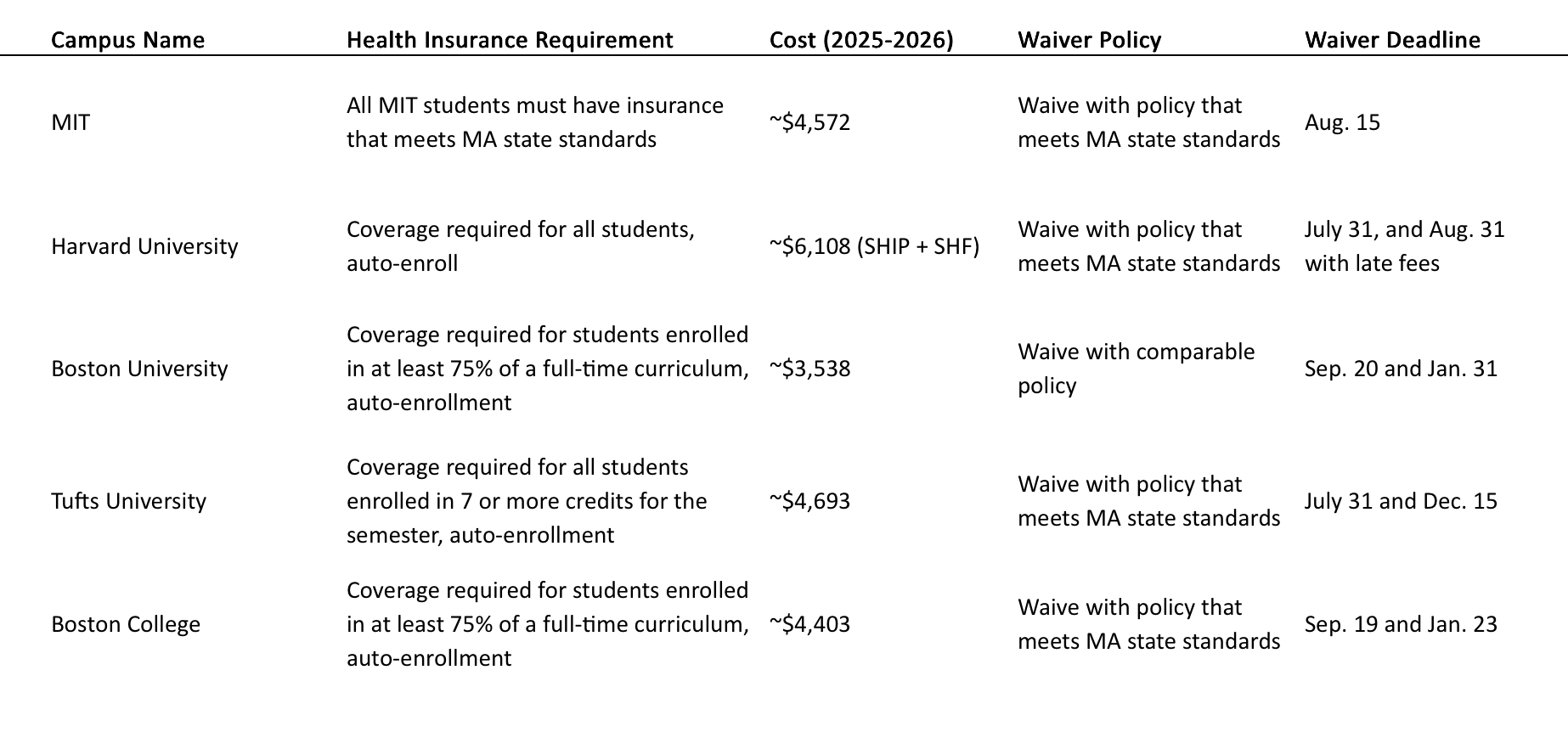
Massachusetts Institute of Technology (MIT) requires all students to have coverage that meets MA standards. The ~$4,572 plan can be waived if students show proof of qualifying coverage by Aug. 15.
Harvard University automatically enrolls all students in a ~$6,108 plan that includes a Student Health Insurance Plan (SHIP) and a mandatory health fee. Waivers are due July 31; late waivers may be accepted until Aug. 31 with a fee.
Boston University requires insurance for students enrolled in at least 75% of a full-time course load. The ~$3,538 plan can be waived with a comparable policy. Deadlines: Sep. 20 and Jan. 31.
Tufts University enrolls students taking 7+ credits per semester in its ~$4,693 plan. Waivers must be submitted by July 31 or Dec. 15 with proof of compliant coverage.
Boston College applies the 75% rule for full-time enrollment and charges ~$4,403 unless students waive with qualifying coverage. Waiver deadlines: Sep. 19 and Jan. 23.
While both public and private institutions are bound by state insurance mandates, the implementation differs sharply.
Waiver policies also differ: public schools typically accept any ACA-compliant coverage, while private colleges often require plans that meet more rigid state benchmarks, potentially disqualifying otherwise sufficient coverage.
This discrepancy places an unequal financial burden on students based solely on where they enroll. A student at UMass Amherst can waive a $2,470 plan with broad flexibility, while a peer at Harvard may be locked into a $6,108 plan unless their policy meets Harvard’s criteria.
For students with their own insurance, especially those on family plans or insured through an employer, these automatic enrollments and confusing waiver processes can result in thousands of dollars in surprise charges.