Michigan students take on more costs with health insurance auto-enrollment
Students may find themselves on the hook for thousands in unneeded health insurance premiums if the system is not navigated correctly.
As college students across Michigan prepare for the fall semester, many may be automatically enrolled in university-sponsored health insurance plans costing thousands of dollars, regardless of whether they already have coverage.
The fine print on these policies varies dramatically between public and private institutions, with some schools requiring insurance for all students, others limiting mandates to international or specialized populations, and most setting strict waiver deadlines. Students who fail to submit proper documentation in time could face unexpected charges and redundant coverage.
[RELATED: UMich spent $100k on illegal immigrant scholarships, triggering federal probe]
A Campus Reform review reveals notable discrepancies in enforcement, costs, and flexibility across Michigan’s higher education landscape.
Public University Systems
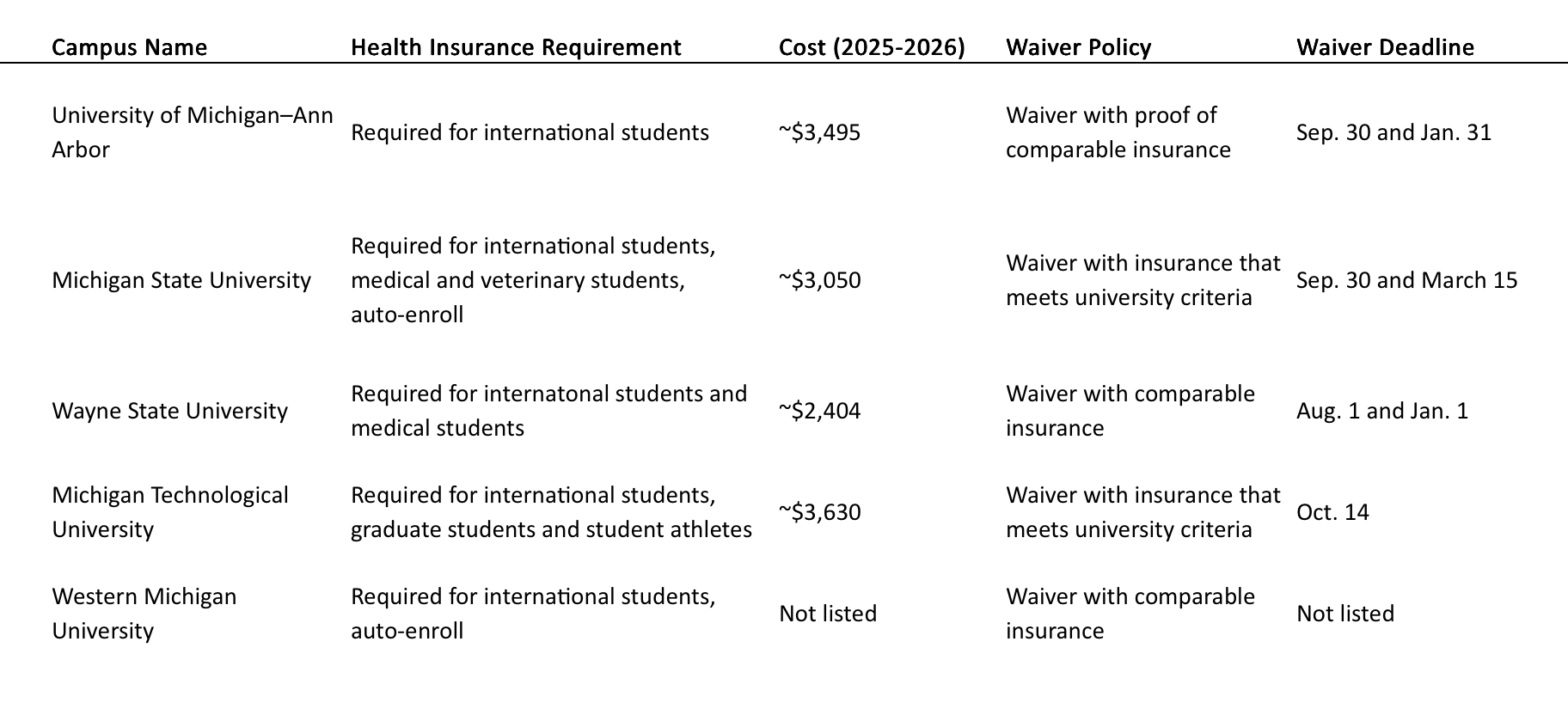
Public universities in Michigan generally require health insurance only for international students, though some extend the mandate to medical, graduate, or student-athlete populations. Waiver policies tend to allow for comparable U.S.-based coverage, though deadlines vary widely.
 Created with Perplexity
University of Michigan–Ann Arbor: Coverage required for international students, with a waiver accepted if comparable insurance is documented. Cost: ~$3,495. Deadlines: Sept. 30 and Jan. 31.
Michigan State University: Coverage mandated for international, medical, and veterinary students, with automatic enrollment. Students may waive if their plan meets university standards. Cost: ~$3,050. Deadlines: Sept. 30 and March 15.
Wayne State University: Insurance required for international and medical students. Waivers are accepted with proof of comparable insurance. Cost: ~$2,404. Deadlines: Aug. 1 and Jan. 1.
Michigan Technological University: Insurance required for international, graduate, and student-athlete populations. Waivers must meet institutional criteria. Cost: ~$3,630. Deadline: Oct. 14.
Western Michigan University: Insurance mandated only for international students, who are automatically enrolled. Waiver policies accept comparable plans. Cost and deadlines are not listed.
Private Universities
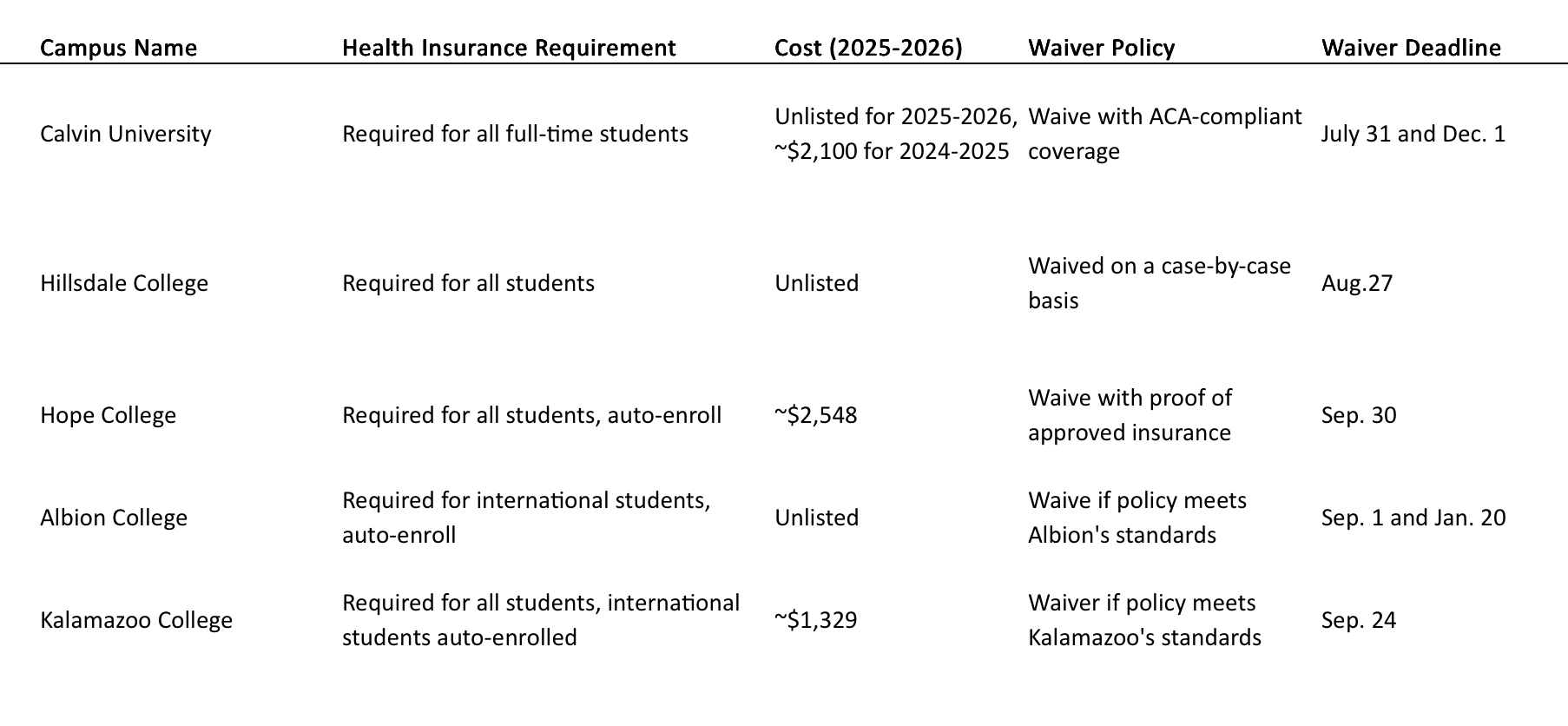
Michigan’s private colleges often impose broader insurance requirements and stricter enforcement. In many cases, all full-time students are subject to automatic enrollment unless they successfully waive out.
 Created with Perplexity
Calvin University: Insurance required for all full-time students. Waivers are accepted with ACA-compliant coverage. While the cost is unlisted for 2025–2026, it was ~$2,100 the prior year. Deadlines: July 31 and Dec. 1.
Hillsdale College: Coverage mandated for all students, though waivers are handled on a case-by-case basis. No cost is listed. Deadline: Aug. 27.
Hope College: Insurance required for all students, auto-enrollment is enabled. Waivers are accepted with proof of approved insurance. Cost: ~$2,548. Deadline: Sept. 30.
Albion College: Insurance mandated for international students, who are automatically enrolled. Waivers are granted if the student’s policy meets Albion’s standards. Cost: unlisted. Deadlines: Sept. 1 and Jan. 20.
Kalamazoo College: Coverage required for all students and international students International students are auto-enrolled. Waivers are accepted if insurance meets Kalamazoo’s standards. Cost: ~$1,329. Deadline: Sept. 24.
Private universities tend to impose broad health insurance mandates on all full-time students, automatically enrolling them in campus-sponsored plans unless a waiver is approved. These institutions often require students to demonstrate ACA-compliant or U.S.-based coverage to opt out.
In contrast, public universities more commonly apply the requirement to specific populations, such as international students, student-athletes, or those in medical and graduate programs. Despite these differences, students at both public and private institutions face steep financial consequences if they overlook waiver deadlines or fail to meet coverage standards.
[RELATED: UMich accepted over $270M in foreign funds, Campus Reform audit finds; feds launch probe]
The health insurance requirements are generally unneeded, as a majority of students already have coverage.
According to the Government Accountability Office, most American undergrads are on employer-sponsored policies belonging to them or someone else, such as a parent or guardian.
Without timely action, students may find themselves unknowingly enrolled in expensive plans and billed for coverage they do not need.