
Vermont students could be auto-enrolled, charged for insurance unless they navigate waiver system
Many students returning to campus in Vermont are under strict health insurance requirements imposed by universities.
If students do not submit a waiver on time, they could be charged thousands of dollars for coverage they may already have.
College students in Vermont are returning to campus this fall not only facing tuition bills, but also steep health insurance charges that vary depending on where they’re enrolled. Both public and private schools in the state require students to carry coverage, but the cost of those mandates can differ by thousands of dollars.
Annual premiums can run as high as $5,000, and missing a waiver deadline almost always means students are stuck footing the bill. For families already straining under tuition hikes and housing costs, these hidden requirements represent another financial obstacle in pursuing a degree.
Public Universities
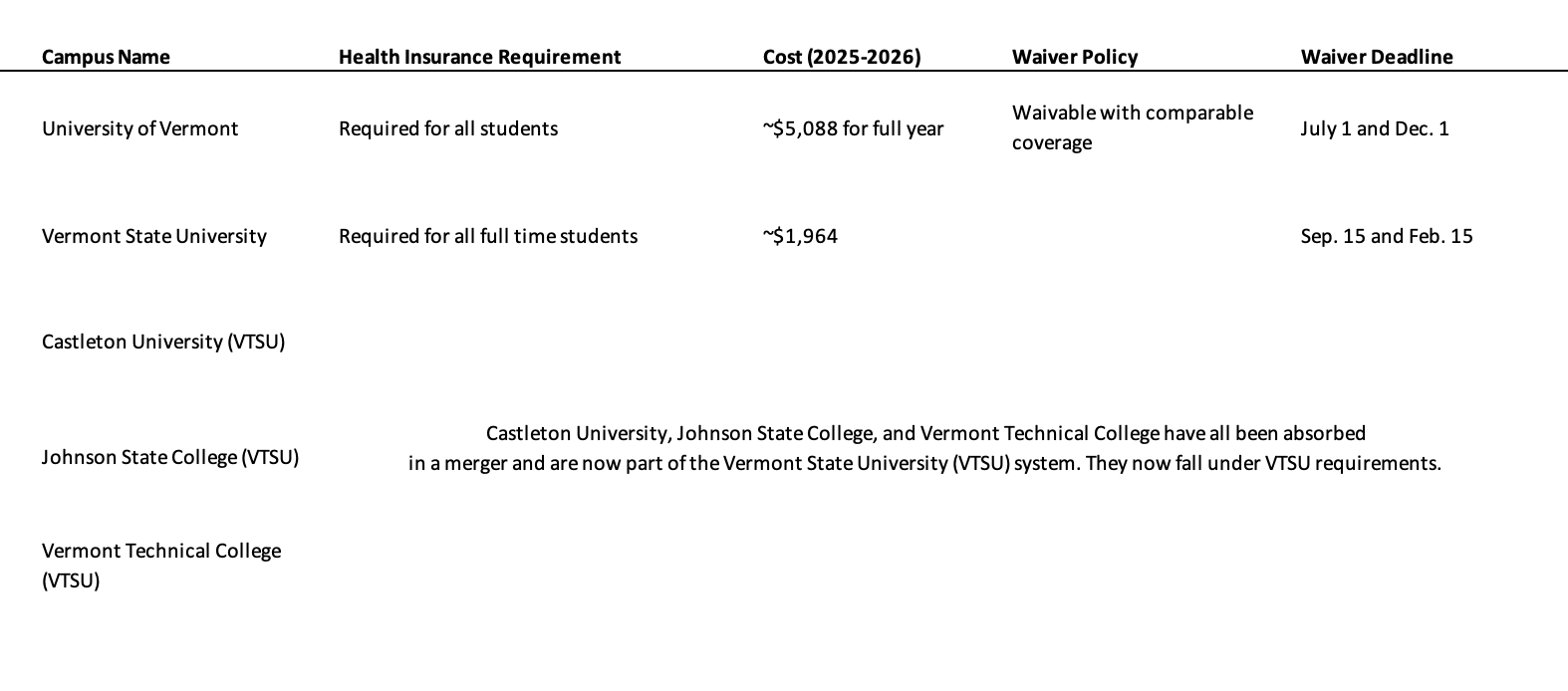
Vermont’s public university system has recently consolidated. In 2023, Castleton University, Johnson State College, and Vermont Technical College merged into Vermont State University (VTSU) as part of a cost-cutting initiative. Now, students at those three campuses must all follow VTSU’s unified health insurance policy.
 Created with Perplexity
University of Vermont (UVM) – Required for all students. Cost: ~$5,088 for the full year. Waivable with comparable coverage. Deadlines: July 1 and Dec. 1.
Vermont State University (VTSU, includes absorbed campuses) – Required for all full-time students. Cost: ~$1,964. Waivable with comparable coverage. Deadlines: Sep. 15 and Feb. 15.
UVM charges the highest premium in the state—more than double VTSU’s rate—though both require every student to maintain insurance.
Private Universities
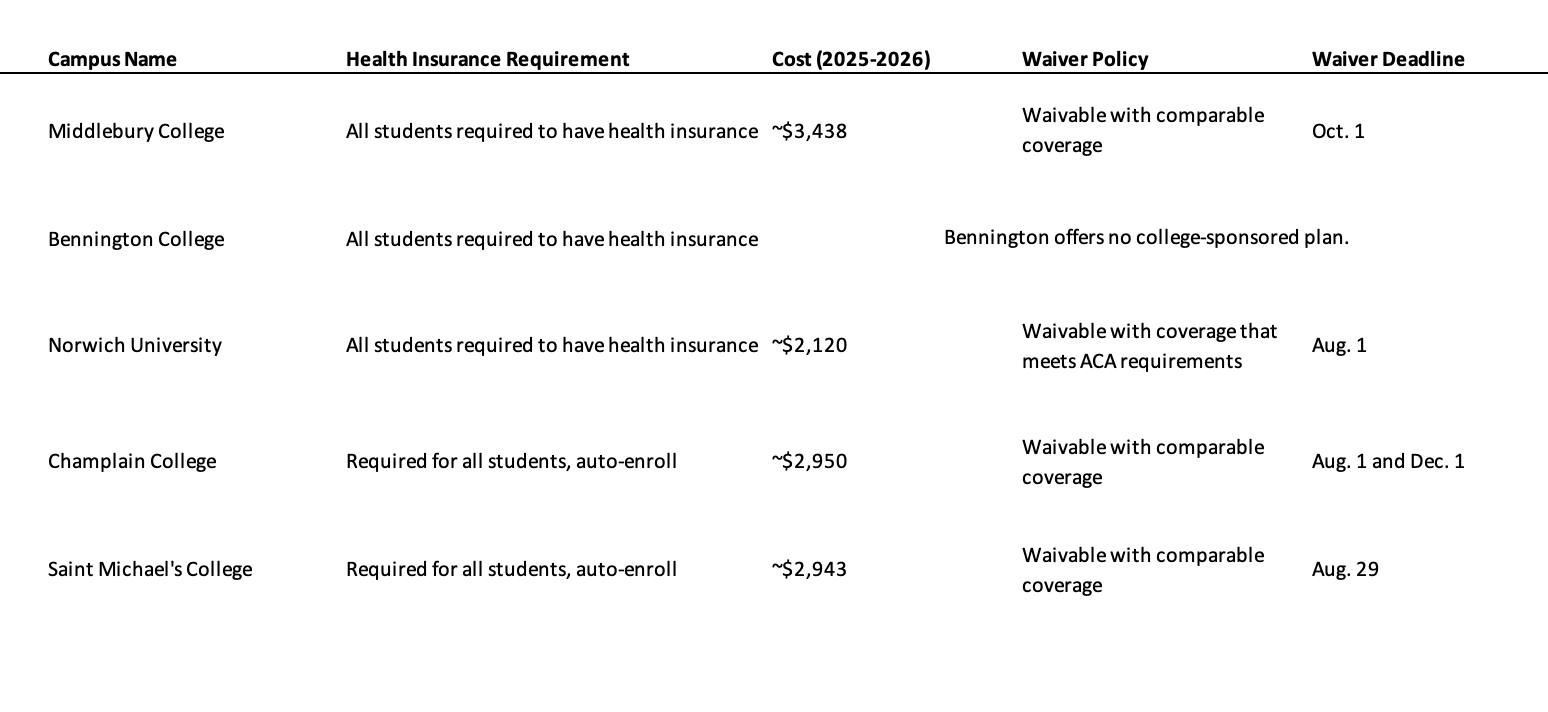
Vermont’s private colleges also impose broad health insurance mandates. Most require all students to carry coverage and automatically enroll those who do not submit proof of an outside plan.
 Created with Perplexity
Middlebury College – Required for all students. Cost: ~$3,438. Waivable with comparable coverage. Deadline: Oct. 1.
Bennington College – Required for all students, but no college-sponsored plan is offered. Students must obtain their own coverage.
Norwich University – Required for all students. Cost: ~$2,120. Waivable with coverage that meets ACA requirements. Deadline: Aug. 1.
Champlain College – Required for all students, auto-enroll. Cost: ~$2,950. Waivable with comparable coverage. Deadlines: Aug. 1 and Dec. 1.
Saint Michael’s College – Required for all students, auto-enroll. Cost: ~$2,943. Waivable with comparable coverage. Deadline: Aug. 29.
For students, these requirements can mean the difference between an affordable semester and a budget-breaking one.
At VTSU, the merger has simplified policies across three campuses but also ended campus-specific flexibility. What was once handled by individual colleges is now governed by a single systemwide mandate.
As tuition, fees, and living costs continue to rise, Vermont’s case shows how health insurance has become another hidden cost of higher education. Families are forced to juggle waiver deadlines, fine print, and steep premiums—often for coverage students already have through a parent’s plan. For many, it’s yet another example of how universities add to the financial burden of earning a degree.