Students at Texas universities may be auto-enrolled in costly policies and billed for thousands
Depending on the institution students choose to attend, they may be on the hook for thousands of dollars in health insurance premiums.
Some schools in the Lone Star State impose the requirement only on international students.
Texas universities are rolling out their updated health insurance requirements for the 2025–2026 academic year, and the rules vary widely depending on whether a school is public or private.
For students and parents, these policies can have a major financial impact. Annual premiums range from about $2,300 to over $4,200, and waiver deadlines are often early in the semester, leaving little room for error. Missing the waiver deadline typically results in automatic enrollment in the school’s plan—an expense that might be difficult to reverse.
The requirements also reflect broader differences between public and private higher education in Texas.
[RELATED: Texas State protesters demand sanctuary campus, accuse Israel of ‘genocide’]
Public University Systems
Public universities—especially large state systems like the University of Texas, Texas A&M, and University of Houston—tend to limit mandatory health insurance to international students and, in some cases, students in health science programs.
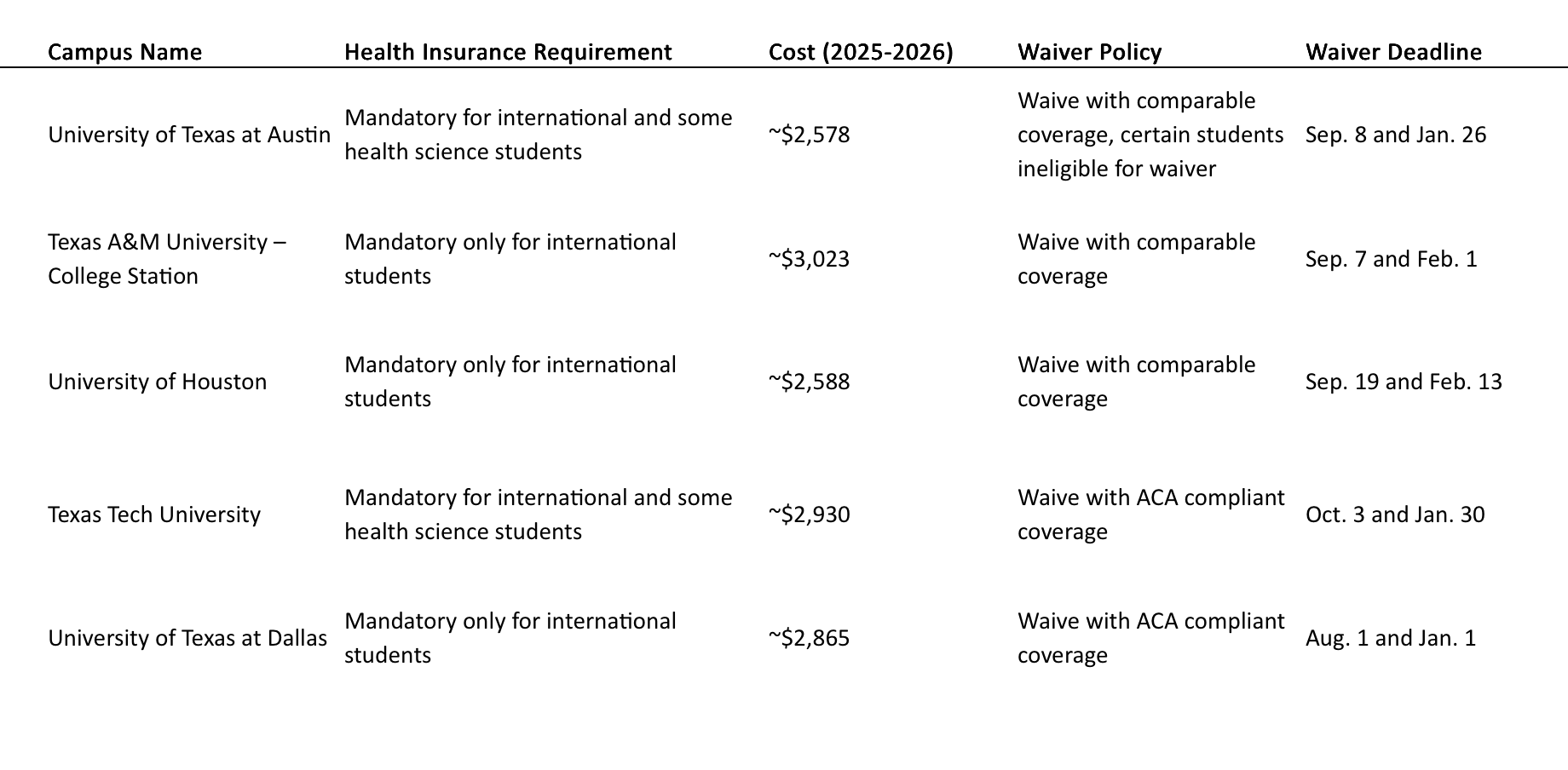
Created with Perplexity
University of Texas at Austin – Mandatory for international students and some health science students. Cost: ~$2,578. Waivable with comparable coverage, though certain students are ineligible for a waiver. Deadlines: Sep. 8 and Jan. 26.
University of Texas at Dallas – Mandatory only for international students. Cost: ~$2,865. Waivable with ACA-compliant coverage. Deadlines: Aug. 1 and Jan. 1.
Texas A&M University - College Station – Mandatory only for international students. Cost: ~$3,023. Waivable with comparable coverage. Deadlines: Sep. 7 and Feb. 1.
University of Houston – Mandatory only for international students. Cost: ~$2,588. Waivable with comparable coverage. Deadlines: Sep. 19 and Feb. 13.
Texas Tech University – Mandatory for international and some health science students. Cost: ~$2,930. Waivable with ACA-compliant coverage. Deadlines: Oct. 3 and Jan. 30.
Private Universities
Private universities in Texas generally apply health insurance requirements to a broader range of students, often including all undergraduates enrolled in a certain number of credit hours. Waiver policies tend to allow opt-outs only with proof of comparable coverage, and costs vary widely between institutions.
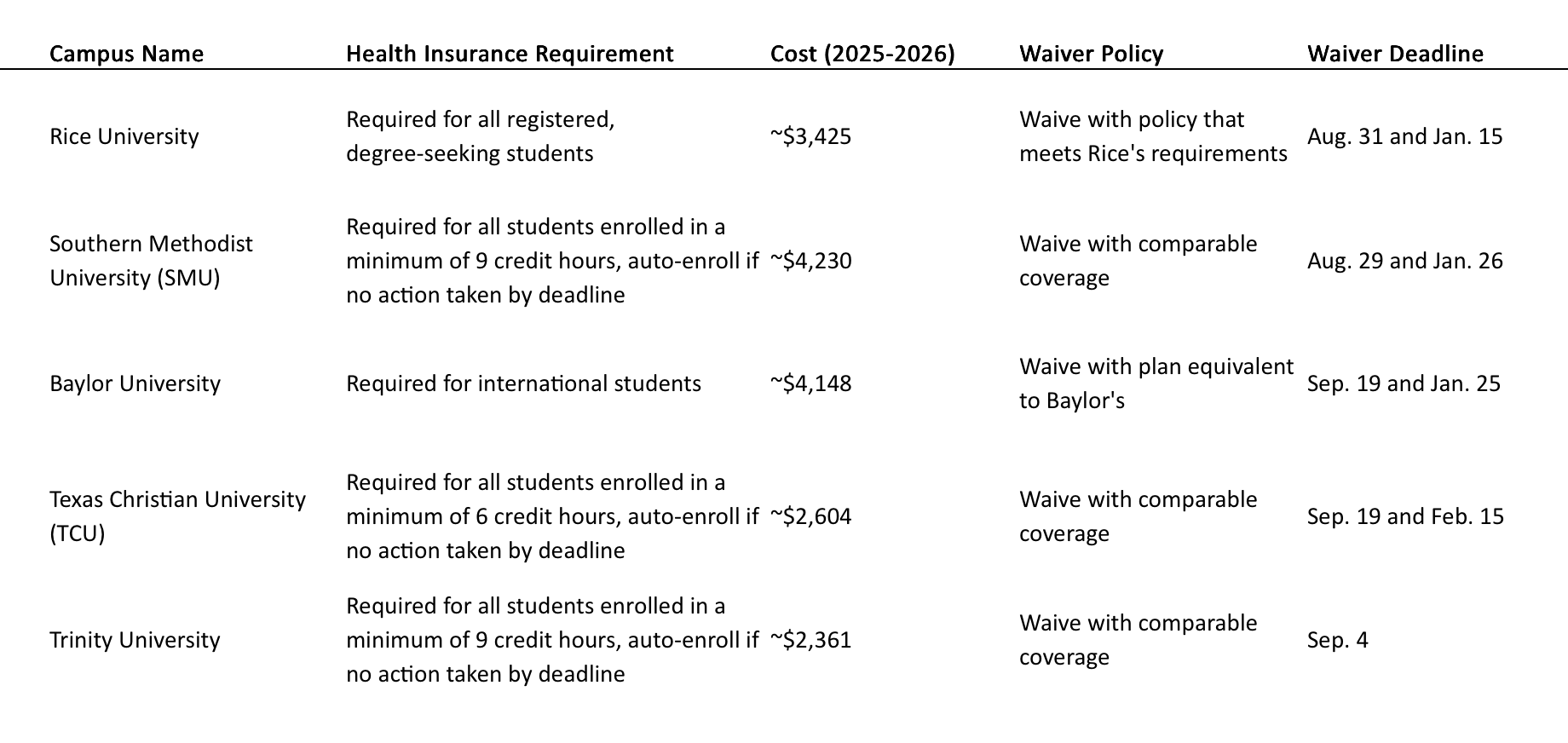
Created with Perplexity
Rice University – Required for all registered, degree-seeking students. Cost: ~$3,425. Waivable with coverage meeting Rice’s requirements. Deadlines: Aug. 31 and Jan. 15.
Southern Methodist University (SMU) – Required for students with 9+ credit hours. Cost: ~$4,230. Waivable with comparable coverage. Deadlines: Aug. 29 and Jan. 26.
Baylor University – Required only for international students. Cost: ~$4,148. Waivable with equivalent coverage. Deadlines: Sep. 19 and Jan. 25.
Texas Christian University (TCU) – Required for students with six or more credit hours. Cost: ~$2,604. Waivable with comparable coverage. Deadlines: Sep. 19 and Feb. 15.
Trinity University – Required for students with nine or more credit hours. Cost: ~$2,361. Waivable with comparable coverage. Deadline: Sep. 4.
While both public and private universities in Texas require health insurance for certain students, the scope and cost of those requirements differ significantly.
Public universities tend to limit mandatory health insurance to international students and, in some cases, students in health science programs. This approach reduces the number of students required to purchase university-sponsored coverage, and often allows domestic students to opt out entirely without showing proof of comparable coverage.
[RELATED: Fleeing Dems disillusion young Texas voters]
Private universities, by contrast, are far more likely to impose coverage requirements on all students taking a minimum number of credit hours. This can mean that even students with no international status or medical program enrollment must either buy the school’s plan or go through the waiver process to prove they have adequate private coverage.
The pricey premiums are often not even needed.
The Government Accountability Office found that most undergrads in the United States are already covered, whether it is through their own plan or under policy belonging to someone else.
In short, public universities in Texas generally target mandatory insurance at high-need or high-risk groups, while private schools apply blanket requirements across much larger portions of their student bodies, often at a higher cost.