Oregon universities' health insurance mandates could automatically bill students over $4,000
Both public and private universities in Oregon have health insurance requirements, but it falls on domestic students to navigate these mandates.
Although all require international students to carry health insurance, some institutions also auto-enroll American undergraduates in costly plans.
As the 2025–2026 academic year begins, Oregon universities are tightening health insurance requirements, and the rules look very different depending on whether students attend a public or private school.
Annual costs range from roughly $1,600 at some public campuses to more than $4,100 at private institutions. Waiver deadlines often fall in the first weeks of the semester, and missing one means automatic enrollment in the school’s plan.
The differences highlight a divide seen elsewhere in higher education: public universities tend to require coverage only for international students, while private institutions impose mandatory plans on nearly all undergraduates.
[RELATED: Massachusetts students may be auto-enrolled in insurance plans that costs thousands]
Public Universities
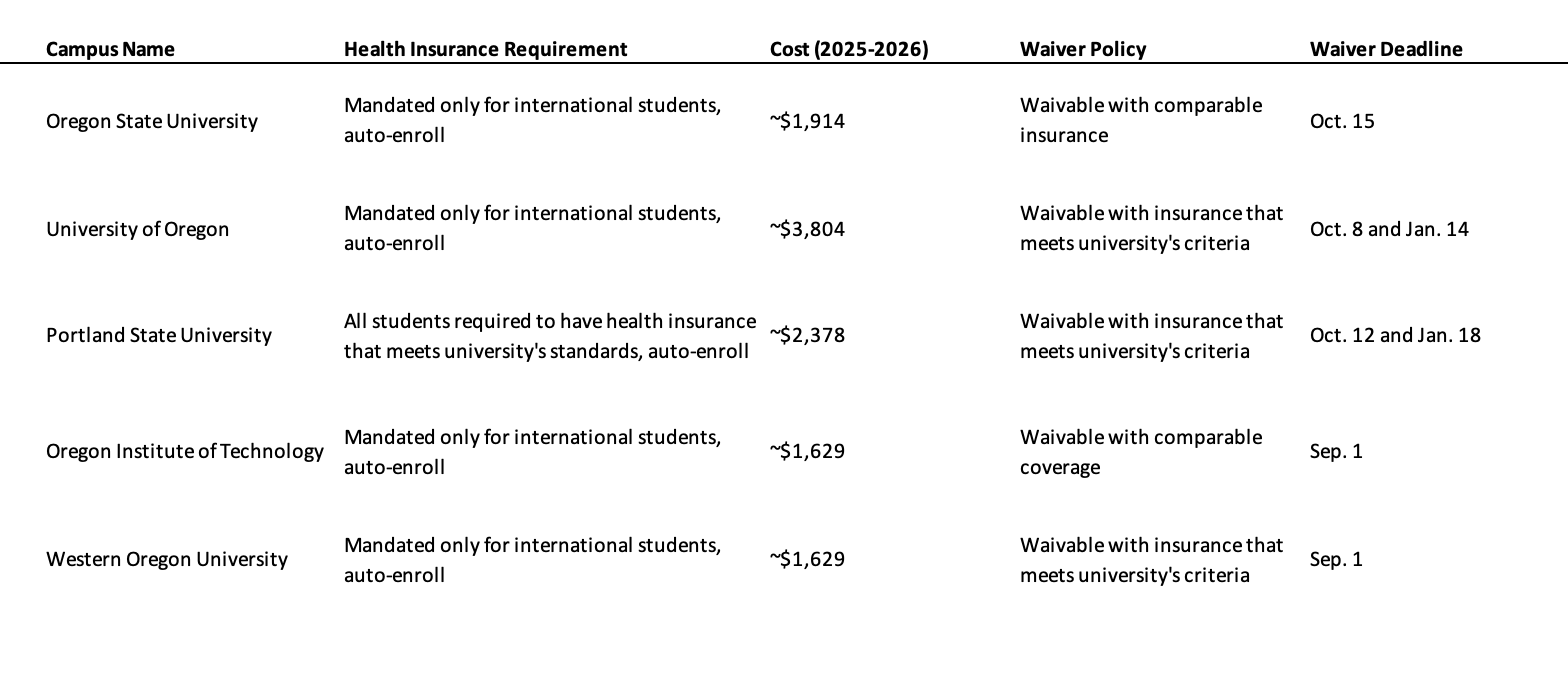
Public universities in Oregon generally restrict mandatory coverage to international students. One of the exceptions is Portland State University, which requires insurance for all students. Premiums are significantly lower than those at private schools.
 Created with Perplexity
Oregon State University – Mandatory only for international students. Cost: ~$1,914. Waivable with comparable coverage. Deadline: Oct. 15.
University of Oregon – Mandatory only for international students. Cost: ~$3,804. Waivable with insurance that meets the university’s criteria. Deadlines: Oct. 8 and Jan. 14.
Portland State University – Required for all students. Cost: ~$2,378. Waivable with insurance that meets PSU’s standards. Deadlines: Oct. 12 and Jan. 18.
Oregon Institute of Technology – Mandatory only for international students. Cost: ~$1,629. Waivable with comparable coverage. Deadline: Sep. 1.
Western Oregon University – Mandatory only for international students. Cost: ~$1,629. Waivable with insurance that meets WOU’s standards. Deadline: Sep. 1.
Private Universities
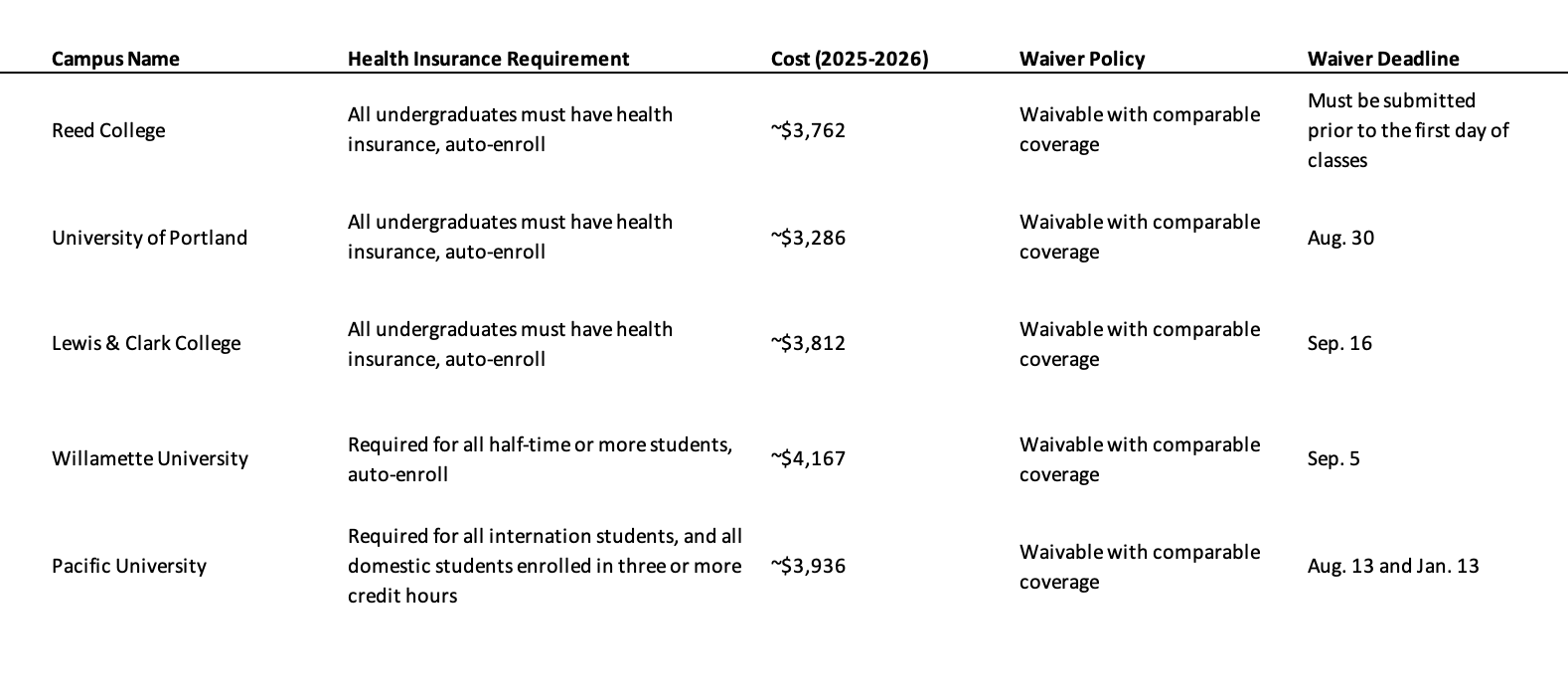
Private universities in Oregon apply health insurance requirements more broadly. Most require all undergraduates to carry insurance and auto-enroll them into costly school-sponsored plans unless a waiver is approved.
 Created with Perplexity
Reed College – Required for all undergraduates. Cost: ~$3,762. Waivable with comparable coverage. Deadline: Before the first day of classes.
University of Portland – Required for all undergraduates. Cost: ~$3,286. Waivable with comparable coverage. Deadline: Aug. 30.
Lewis & Clark College – Required for all undergraduates. Cost: ~$3,812. Waivable with comparable coverage. Deadline: Sep. 16.
Willamette University – Required for all half-time or more students. Cost: ~$4,167. Waivable with comparable coverage. Deadline: Sep. 5.
Pacific University – Required for all international students and all domestic students with 3+ credit hours. Cost: ~$3,936. Waivable with comparable coverage. Deadlines: Aug. 13 and Jan. 13.
[RELATED: Office of Civil Rights opens investigation into Oregon Department of Education]
Both public and private universities in Oregon impose health insurance mandates, but the scope and price tag differ dramatically. Public institutions largely limit the requirement to international students or offer generous waiver options, with premiums ranging from $1,600 to $3,800.
Private colleges, on the other hand, enforce blanket requirements that capture nearly every student, with some plans approaching $4,000 per year. For families already grappling with steep tuition hikes, that means another mandatory cost, despite the fact that most undergraduates are already covered through a parent’s or individual plan, according to federal data from the Government Accountability Office.
If incoming students fail to navigate the waiver and enrollment process properly and on time, they could find themselves paying thousands more in unnecessary costs.