
PROF. JENKINS: If DEI is so good for men, why hasn’t it been?
In their efforts to attract more women, higher education institutions have achieved that goal but at the cost of alienating men. Indeed, in many cases, they haven’t just alienated men—they’ve positively vilified them.
Rob Jenkins is a Higher Education Fellow with Campus Reform and a tenured associate professor of English at Georgia State University - Perimeter College. The opinions expressed here are his own and not those of his employer.
As the Trump administration continues its methodical crackdown on “diversity, equity, and inclusion” programs on college campuses, a new talking point has emerged on the left: This is a worrisome development because it will somehow negatively impact male students.
A recent Washington Post headline reads, “Trump’s attack on DEI may hurt college men, particularly white men.” It goes on to claim that the “administration’s ban on diversity, equity, and inclusion…may impact gender balancing practices that often benefit college men.”
James Surowieki, a financial writer for The New Yorker, posted the story on X with the following comment: “This is the great paradox of Trump’s war on DEI: universities’ desire to have diverse, gender-balanced student bodies was almost certainly going to lead to guys getting a meaningful step up in admissions in the years to come. That’s now done.”
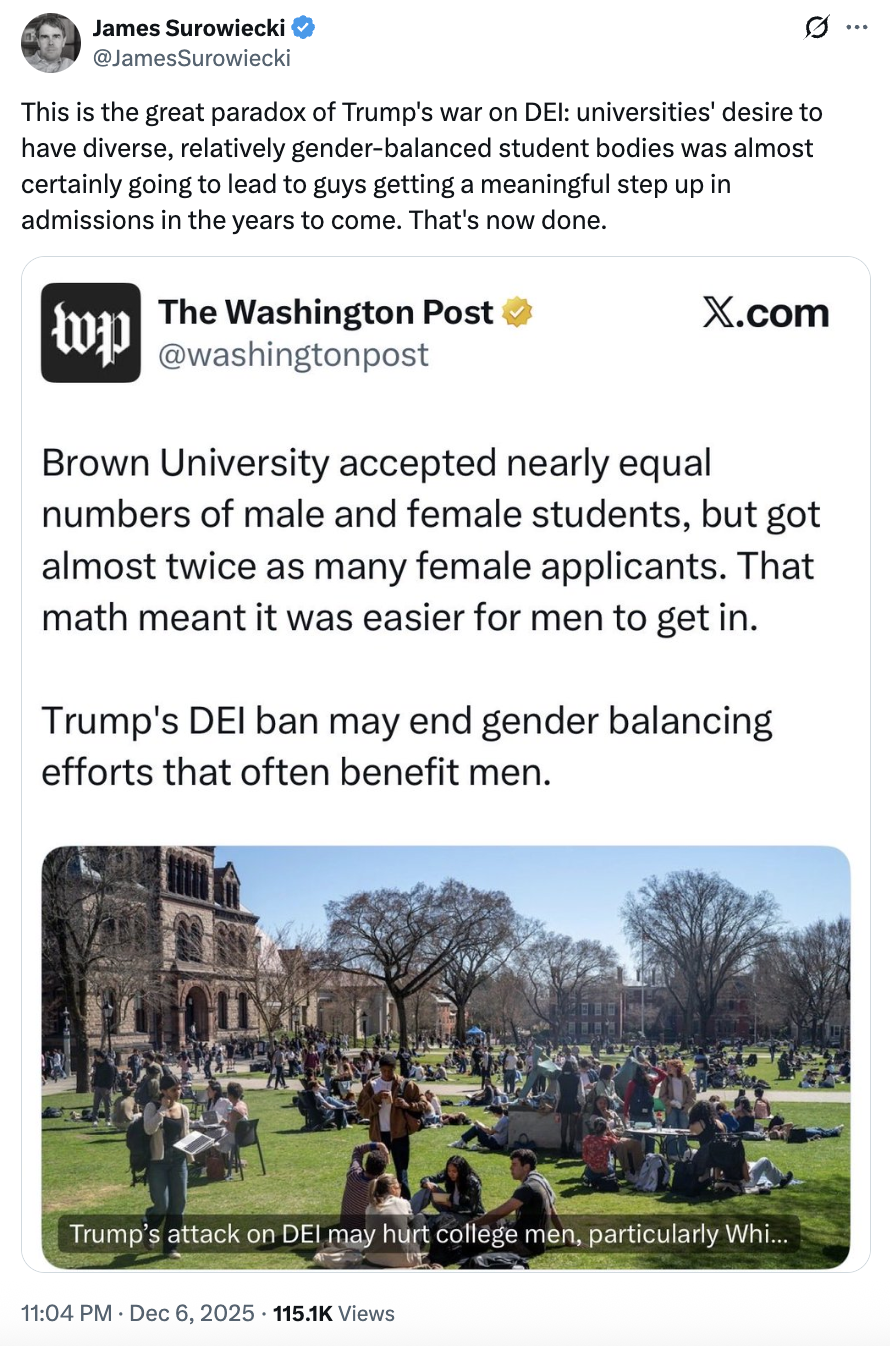
The problem with this argument is rather obvious: If DEI programs are such a boon to young men, why haven’t they been?
You’ve probably heard the disclaimer, commonly issued by investment companies, that “past performance is not indicative of future success.” That may well be true, but when it comes to programs or policies, past failures are almost always indicative of future failures.
[RELATED: PROF. JENKINS: The limits of academic freedom]
After all, DEI has been around in some form or other for at least a couple of decades. And during that time, what has happened to the male population at our nation’s colleges and universities? According to a 2023 study from the Pew Research Center, total male enrollment has dropped by more than one million since 2011. Men now make up only about 44 per cent of college students nationwide.
The reasons for this decline are many. In an op-ed for MSN, Diana Rose points out that many men now find the investment of time and money required to obtain a four-year degree no longer worth it. The rise of technology and the lure of lucrative careers in the skilled trades have created other pathways to success.
She also notes that the atmosphere on campus isn’t always “compatible with traditional masculine ideals,” which is a nice way of saying universities have become feminized.
And therein lies the main problem. In their efforts over the past several decades to attract more women, higher education institutions have achieved that goal but at the cost of alienating men. Indeed, in many cases, they haven’t just alienated men—they’ve positively vilified them.
[RELATED: PROF. JENKINS: Publishing professors’ syllabi is a good thing]
In 2011, Obama’s Department of Education issued a “Dear Colleagues” letter to college and university administrators across the country that effectively gutted due process for students accused of sexual assault on campus—almost all of whom, of course, were men.
According to the National Association of Scholars, that letter “created a disastrous system for investigating reports of sexual misconduct. [It] reduced the standard of evidence for establishing guilt, prevented the accused from seeking legal help, and inappropriately gave colleges, not law enforcement, the role of evaluating cases and rendering justice.”
The letter was withdrawn in 2017 by Trump’s first Secretary of Education, Betsy DeVos, but the damage was done. Many young men began to see college campuses as places that were openly hostile to them—where, even if they hadn’t done anything illegal or violated campus policies, one accusation could ruin their life.
Tales of falsely accused male students and their subsequent ordeals were rampant during Obama’s second term. Campus Reform reported on one such story in 2015, when a student at Amherst college was expelled for rape two years after the alleged incident occurred despite all the evidence being in his favor.
All of this was carried out, of course, in the name of “equity,” “fairness,” and “social justice.” In other words, it was all part of what we now call DEI. And it was one of the main factors that ultimately led male students to flee higher education in droves.
Yet we’re now told that eliminating DEI programs will somehow hurt men? Give me a break. Getting rid of DEI and its biased agenda—specifically, biased toward males and especially white males—will have a positive effect on all of higher education, men not least.
Indeed, if young men start to believe colleges will treat them fairly, they might even come back.
Editorials and op-eds reflect the opinion of the authors and not necessarily that of Campus Reform or the Leadership Institute.